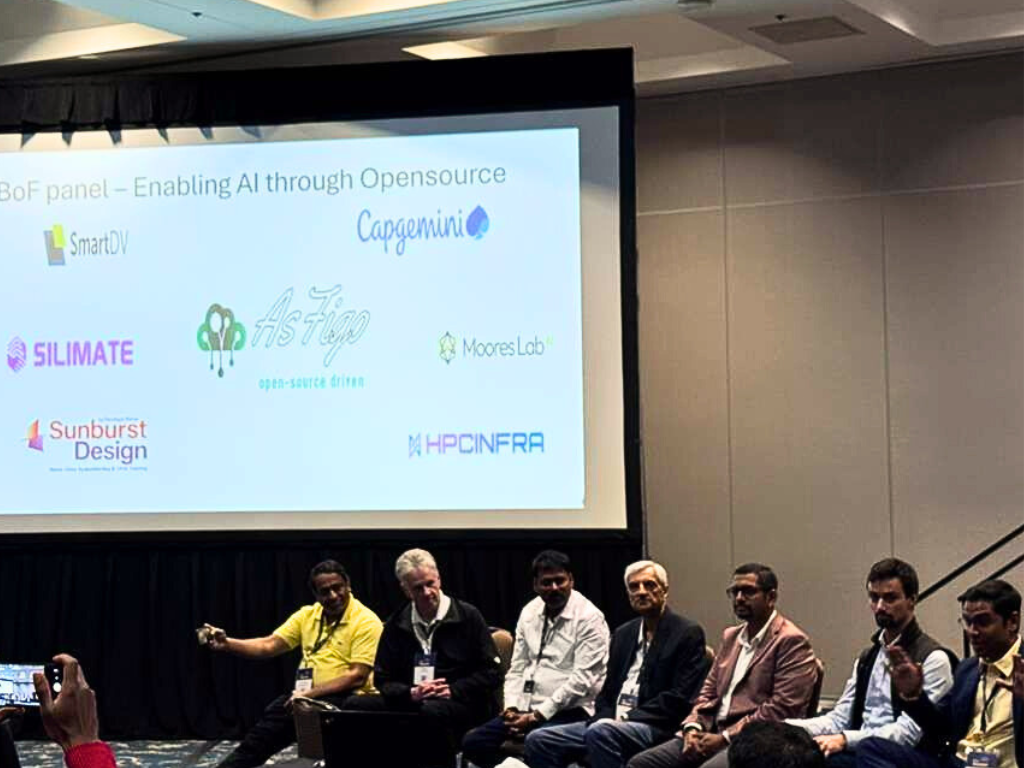
The rapid evolution of AI is beginning to reshape how complex hardware systems are designed and verified. At this year’s Design and Verification Conference (DVCon), our Chief AI Officer Shashank Chaurasia joined an engaging Birds-of-a-Feather session in which engineers, researchers, and industry leaders to explore a key question:
How can agentic AI accelerate the future of hardware verification?
During the discussion, participants explored emerging ideas around AI-driven workflows, open infrastructure, and collaborative development models for the semiconductor ecosystem. The session was hosted by Asfigo CEO Srinivasan Venkataramanan, and featured insights and perspectives from leaders in the space, including Clifford Cummings (Sunburst Design), Deepak Tala (SmartDV), Yatin Trivedi (Capgemini), and Asif ETV (HPC Infra).
Several important themes emerged from the conversation:
1. Agentic AI for Engineering Productivity
AI agents have the potential to automate repetitive verification tasks, assist with test generation, and help engineers navigate complex codebases and design environments. Rather than replacing engineers, these tools aim to augment human expertise and dramatically accelerate iteration cycles.
2. The Importance of Open Frameworks
Participants emphasized that open infrastructure and shared tooling can help the community experiment more rapidly with new AI-driven approaches. Open collaboration lowers barriers for researchers and startups to contribute novel ideas to the verification stack.
3. Industry–Academia Collaboration
Many of the most promising advances in AI for chip design are happening at the intersection of academia and industry. Events like DVCon provide a valuable forum for connecting researchers with practitioners who are solving real-world verification challenges.
Conversations like this help shape the future of the ecosystem by bringing together diverse perspectives and experiences.
The next phase of innovation will depend on continued collaboration across the community—engineers, researchers, and tool developers working together to build more intelligent, adaptable design workflows.