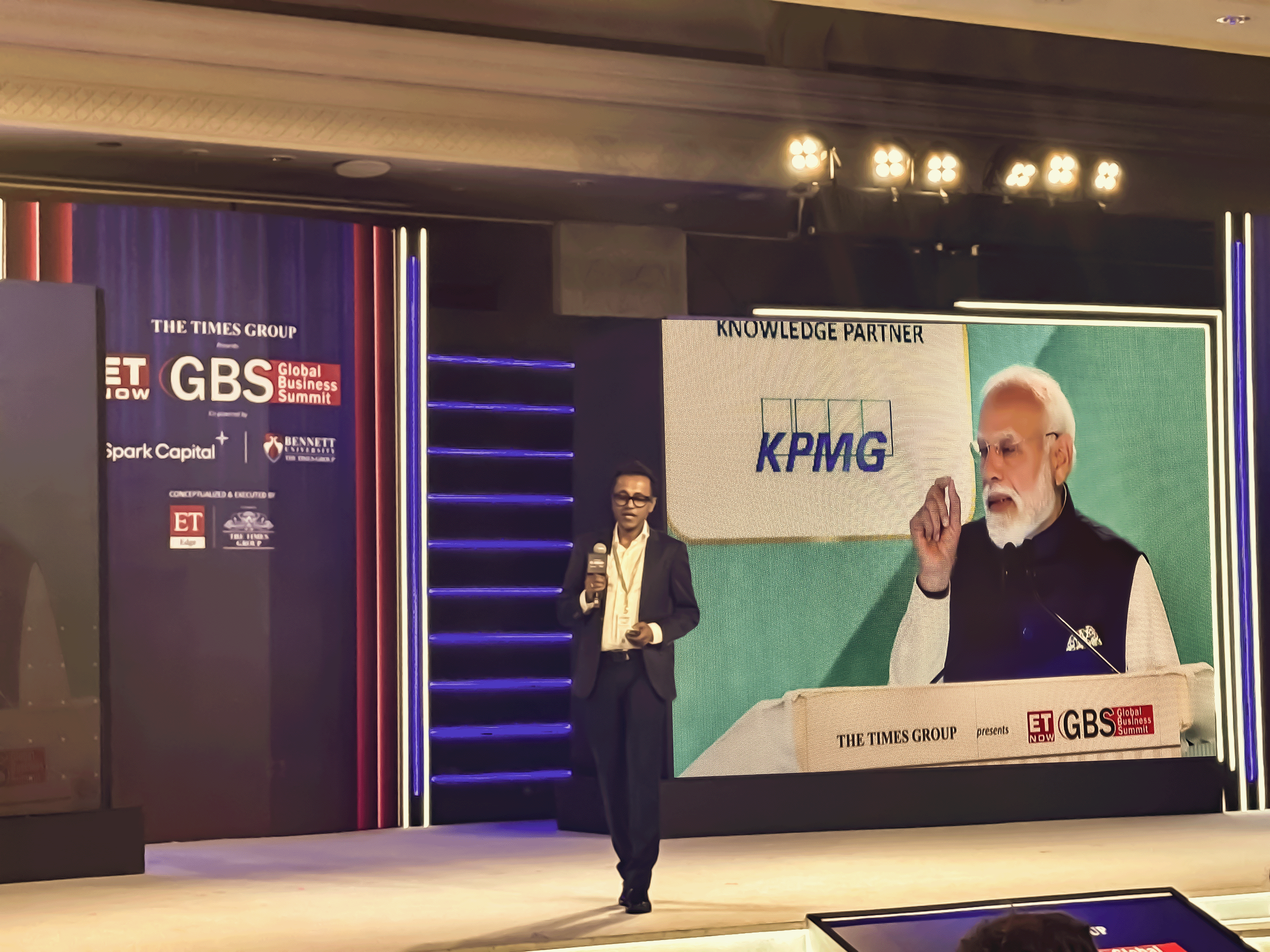
At the 2026 ET NOW Global Business Summit in New Delhi, the global conversation centered on a defining question: who will lead the next era of technological transformation? Hosted by The Times Group, the summit convened heads of state, industry titans, and innovators under the theme “A Decade of Disruption. A Century of Change.” India's Prime Minister Shri Narendra Modi underscored India’s ambition to stand at the forefront of AI advancement, pointing to the country’s digital public infrastructure, startup velocity, and research momentum. Alongside global leaders including Queen Rania AlAbdullah, Charles Michel, Sir Martin Sorrell, David Schwimmer, and Renuka Jagtiani, Moores Lab AI CEO Shelly Henry brought a critical perspective to the stage: AI is not just accelerating innovation—it is redefining who gets to innovate.
In his keynote, “The New Silicon Era: How AI Is Redefining Who Gets to Build Chips,” Henry outlined a structural shift underway in the semiconductor industry. For decades, chip design has been constrained by long development cycles, escalating costs, and a narrow pipeline of specialized talent. AI changes that equation. By embedding intelligence directly into the silicon engineering workflow, Moores Lab AI is compressing design timelines, increasing transparency across complex systems, and lowering barriers to entry for emerging innovators. The message resonated strongly in India, where government policy, private capital, and entrepreneurial energy are converging around deep tech. Democratizing semiconductor design is not a theoretical ambition; it is an economic catalyst capable of unlocking new industries and strengthening national competitiveness.
Henry also joined the high-profile panel “Innovators Unplugged: No Slides, Just Breakthroughs,” where discussions ranged from quantum computing and AI-driven drug discovery to chip sovereignty, ethical deployment, and the geopolitical stakes of advanced hardware. The throughline was clear: AI is becoming foundational infrastructure. For investors and policymakers alike, the opportunity lies in enabling tools that expand participation rather than concentrate power. As Henry emphasized, when AI reduces friction in silicon development, it does more than optimize workflows—it broadens access to the most strategic layer of modern technology. In a summit defined by ambition and global leadership, Moores Lab AI’s message was precise: the future of computing will belong to those who make it possible for more people to build it.