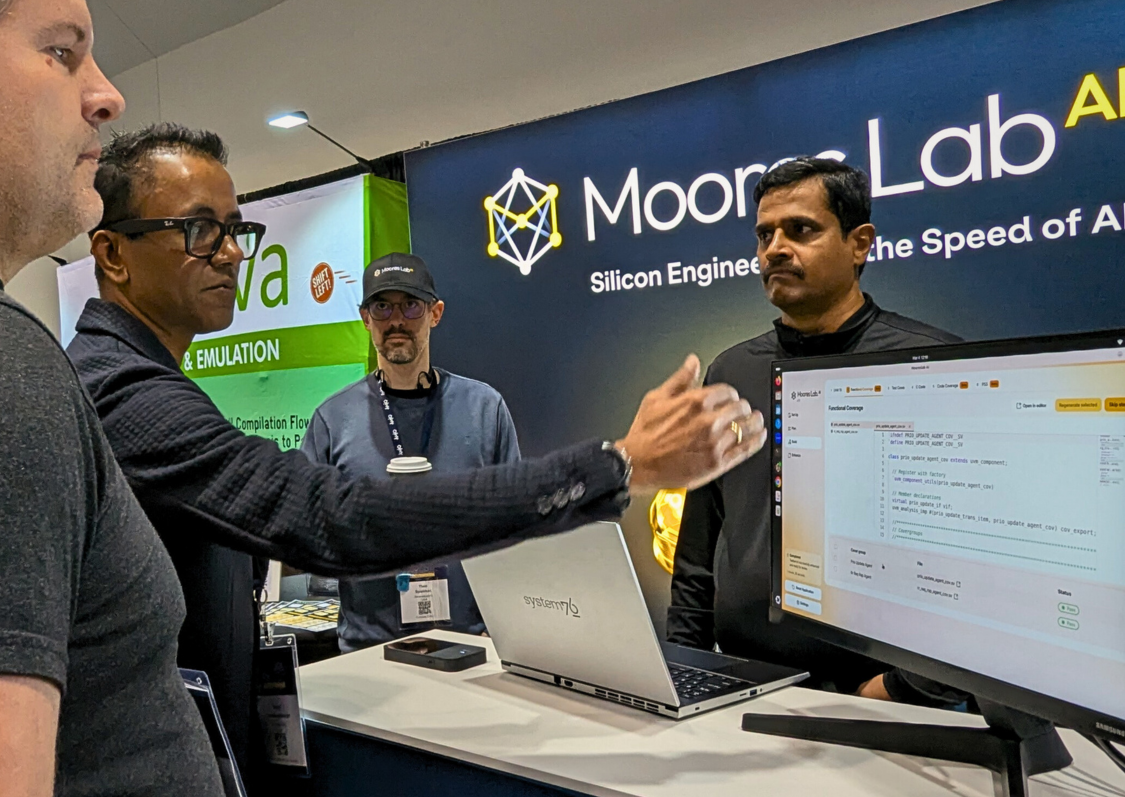
A rare spotlight from EE Journal is turning heads across the semiconductor industry, and Clive (Max) Maxfield’s latest piece makes one thing clear: something big is changing in how chips get built. This veteran journalist doesn’t often highlight partnerships, so when he does, it signals something meaningful. His writeup on the collaboration between Breker Verification Systems and Moores Lab AI reflects a growing realization across the industry: verification is at a breaking point, and incremental improvements are no longer enough. Read the full article AT THIS LINK.
What makes this partnership notable is not just the technology, but the way it connects two historically separate layers of the flow. VerifAgentTM can ingest specifications and automatically generate verification assets such as test plans, UVM testbenches, and assertions, while Breker’s production-proven synthesis technology transforms those models into system-level tests across simulation, emulation, FPGA prototyping, and post-silicon environments. The result is a unified, AI-driven verification pipeline that replaces fragmented, manual effort with an integrated and intelligent system, improving both productivity and quality.
As Maxfield points out, verification today can dominate 6 to 12 months of the chip development cycle, and the promise of 10x faster development at significantly lower cost is not just ambitious, it is necessary. What we are seeing is the emergence of a new model, where AI is not just a tool but an active participant in engineering workflows. For an industry facing unprecedented complexity, this is more than progress. It is a signal that the future of silicon development is being rewritten in real time.