Journey
“Great companies are born from the ability to do difficult things, not because they’re easy, but because they matter.”
— Jensen Huang
In 2005, I got my first PC—an Intel Celeron running Windows XP—and it sparked a fascination with how software talks to hardware. I taught myself C and C++ and built a small Visual Studio app to plot mathematical functions. That simple project ignited a lifelong obsession with computation and design.
In college, I immersed myself in processor architectures, embedded systems, Linux, and VLSI—building tiny intelligent systems powered by just 5 volts. I experimented endlessly with FPGAs, Atmel chips, SPICE, and Proteus, learning by bridging hardware and software.
In 2010, I came to the U.S. for graduate school and joined DARPA’s SyNapse project, helping design the digital fabric linking neural processors at HRL Labs. Since the chips weren’t ready, I wrote C and Perl scripts to generate Verilog code simulating neural networks, even booting Linux on an FPGA to visualize neural activity in Matlab.
That experience taught me something lasting: with limited tools and the right mindset, you can build powerful systems that exceed expectations.
Industry
Over the next 13 years, I worked across the semiconductor landscape at Intel, Qualcomm, Microsoft, and a handful of startups. I shifted from FPGA systems to hardware verification, gaining a front-row seat to both the progress and the pain points of chip development.
Tooling has evolved for decades. But one thing hasn’t changed, which is that verification is still painfully slow and expensive.
At the enterprise level, verification dominates both the cost and the schedule. For smaller players, it’s often an impenetrable barrier to entry. Today’s hardware languages and verification methods just haven’t kept up with the pace of modern engineering. Moving faster means rethinking tools entirely that feel more like software: intuitive, iterative, and built for engineers. I expand on this idea in my recent Forbes article, where I look at modern hardware languages and why raising the level of design intent is becoming essential for how engineers build.
Another major challenge is the industry’s closed nature. That lack of openness makes it hard to attract new talent, especially when so many bright minds are drawn to AI, cloud, and full-stack software. If we want to grow, hardware has to become as dynamic and accessible as the industries surrounding it.
I have always viewed large language models not as autonomous systems, but as AI that augments engineers and amplifies human judgment. This principle has shaped the architecture and philosophy behind every product we build at Moores Lab AI.
That philosophy crystallized during a breakthrough moment when I built our first agent-based AI system capable of ingesting a hardware specification, reasoning about design intent, and autonomously generating a complete verification environment with minimal feedback. While our current platform is significantly more advanced, that early system validated a core insight that verification is fundamentally a reasoning problem, and one that AI agents, guided by human intent, are uniquely suited to solve.
Those realities of friction, inefficiency, and inaccessibility are what planted the seed that would eventually become Moores Lab AI.
Moores Lab AI
At Moores Lab AI, I drive the company’s vision and lead the design and development of our agentic AI platform and software-first verification stack. Drawing on deep experience across hardware, software, and AI, I’ve architected systems where AI agents reason over hardware specifications, design intent, and verification outcomes to autonomously generate, adapt, and optimize verification workflows.
I’m also focused on unifying the entire silicon development lifecycle—spanning architecture, design, verification, and physical implementation—into a single, intelligent, software-driven platform. My work emphasizes building programmable, explainable, and deterministic tools that integrate seamlessly into real-world semiconductor environments, transforming verification from a manual, script-heavy process into an agent-driven system that accelerates development while preserving the rigor and trust required for silicon production.
At Moores Lab AI, we’ve built a team that doesn’t shy away from complexity. We’re passionate, experienced, and focused on solving hard problems the right way. I’ll be honest—at the start, gaining traction was tough. Even with four decades of combined experience, breaking into this space isn’t easy.
But we learned quickly: semiconductors don’t allow shortcuts. “Move fast and break things” doesn’t apply here. There’s no such thing as a casual pilot. There’s no room for trial and error, as success demands quality, precision, and reliability from the start.
So we doubled down on what matters most: building high-quality tools that actually work. By combining deep hardware, software, and AI expertise, we’ve built a modern stack that makes verification faster, more intelligent, and significantly more efficient.
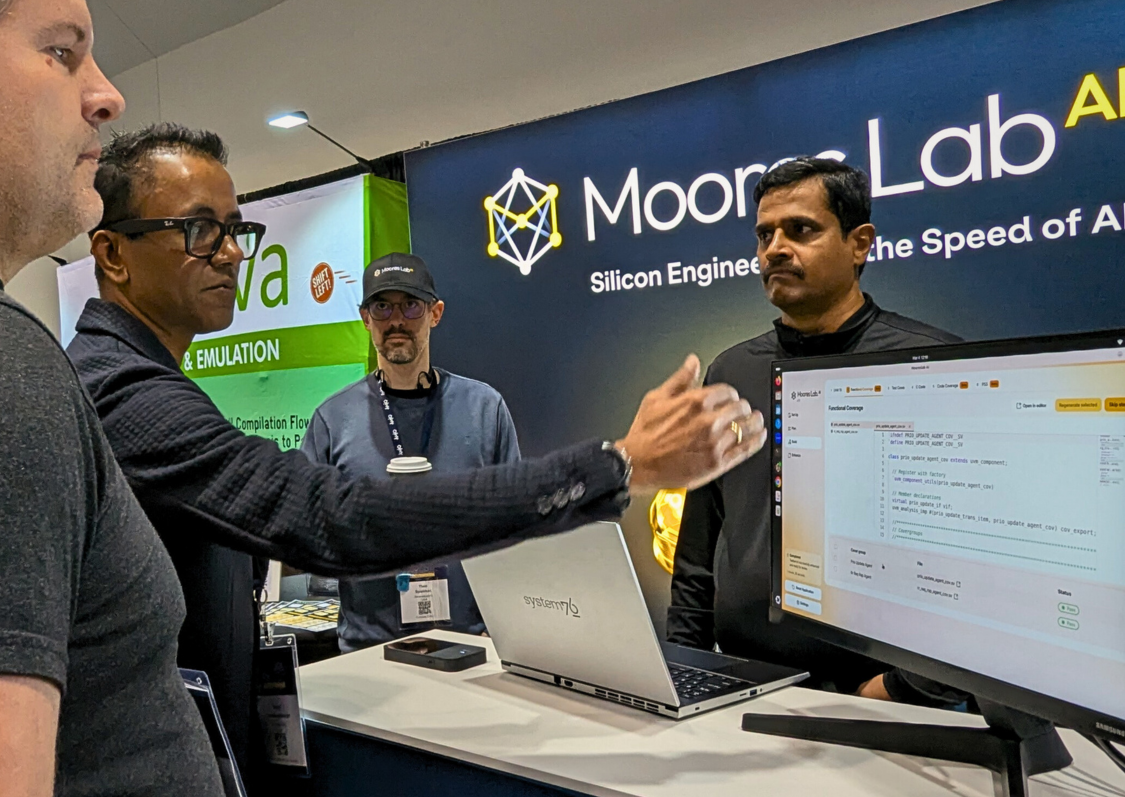
The testimonials reflect that focus. Our customers are seeing meaningful impact on timelines, cost, and how confident they feel moving through the design process.
At Moores Lab AI, we believe the next great leap in semiconductors isn’t about squeezing in more transistors. It’s about creating smarter tools that empower every team—from startup to enterprise—to build great silicon faster, better, and more accessibly than ever before.
— Sirish