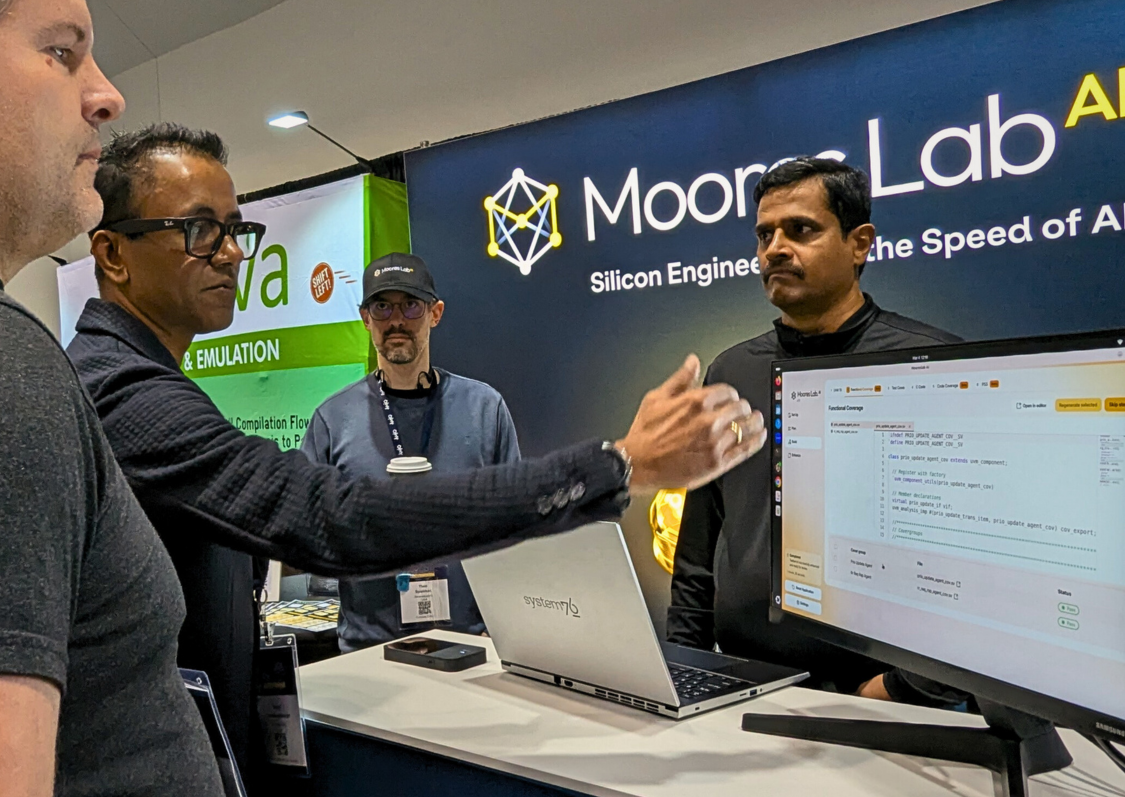
AI is rapidly reshaping electronic design automation, and the market is responding. In the past year alone, more than $400 million has flowed into startups building AI-powered chip design tools. On a recent episode of the SBT Podcast hosted by Justin Kinsey, Sirish Kumar Munipalli, Co-Founder and CTO of Moores Lab AI, addressed the question on many engineers’ and investors’ minds: will AI replace human chip designers? His answer was clear—absolutely not. Instead, AI is poised to elevate them.
Sirish brings more than 15 years of hands-on experience in FPGA prototyping and system-level architecture, having worked on accelerators, neuromorphic processors, and complex SoCs where every design decision carries technical and commercial consequences. That depth of experience shapes how he and the Moores Lab AI team are building their platform. Rather than creating a “ChatGPT for chip design,” they are developing intelligent agents that reason through engineering problems, preserve design context, and generate explainable insights. The focus is not on auto-generating code, but on shortening feedback loops, increasing visibility across the design flow, and helping engineers understand system behavior earlier and more clearly.
This distinction matters. AI in EDA is not about automation for automation’s sake—it’s about unlocking better upstream architectural exploration and enabling smarter decisions before costly downstream issues emerge. As Sirish shared on the podcast, deeper agent understanding gives teams the flexibility to explore bold ideas with confidence, without gambling on whether the design will work at the end. That is the innovation driving Moores Lab AI forward: empowering engineers to dream bigger, move faster, and build better chips in an industry where precision and timing define success.